27.9k
Shares
.png)


Nepal-Russia relations are entering their 70th year. In a written interview with Lumbini Voice Editor-in-Chief Tikaram Khadka, the Russian Ambassador to Nepal, Aleksei Novikov, shared his thoughts on the relationship between the two countries, their mutual cooperation, and Russia’s contributions to Nepal’s education and infrastructure sectors- as well as his reflections on his Ten year stay in Nepal and the enduring goodwill between Nepal and Russia.
1. How do you assess the current changing political situation in Nepal? Do you think all these circumstances can give a new direction to Nepal-Russia relations?
The political situation in Nepal is indeed undergoing notable changes, yet it is important to view these developments as part of the country’s natural democratic evolution. Periods of political transition are never simple, but they often open new opportunities for dialogue and renewal of trust within society.
As for our bilateral relations, we do not see the current circumstances as an obstacle, but rather as a chance to further strengthen the foundation of mutual understanding and cooperation between Russia and Nepal. Our countries have traditionally enjoyed relations built on respect, equality, and the absence of contradictions — and I am confident that this constructive spirit will continue to define our partnership in the future.
2. Nepal and Russia have shared more than 69 years of diplomatic relations. In the current global context, which areas should be prioritized to further strengthen these ties?
In the current global context, both sides have many opportunities to further strengthen this partnership in areas of shared interest.
Tourism remains one of the most promising spheres. We note a steady increase in the number of Russian visitors to Nepal: in 2024, tourist arrivals reached a record level of 13.7 thousand people, clearly demonstrating the growing interest of Russian travellers in Nepal. During the first nine months of the current year, more than 8 thousand Russians visited Nepal, almost 2 percent more than in the same period of 2024. This upward trend not only exceeds pre-pandemic levels but also reflects the wider appeal of Nepal as a destination combining spiritual heritage, natural beauty, and hospitality.
Another key priority is education and academic cooperation. Thousands of Nepali professionals have graduated from Soviet and Russian universities, forming an invaluable human bridge between our peoples. When I first arrived in Nepal, there were only about 14 Russian government scholarships available annually for Nepali students. Today, that number has grown to 50, with a clear prospect of exceeding one hundred in the near future. This steady increase reflects our shared commitment to expanding opportunities for Nepali youth to study in Russia across a wide range of fields, from medicine and engineering to information technology and the humanities.Cultural and spiritual exchange also remains a vital link between our nations. The shared Buddhist heritage, the close interaction between monasteries and religious communities, and regular participation of Nepali representatives in major Russian Buddhist forums in Ulan-Ude and Elista have become a hallmark of our cooperation.
At the same time, we see considerable potential in joint work in hydropower and agriculture. Nepal possesses immense hydroelectric resources, and Russian companies have strong expertise in energy engineering and project design. Agricultural collaboration is another promising field, for instance fertilizer supply and greenhouse technologies or training Nepali specialists in Russia. These projects would enhance food security and contribute to sustainable rural development.
3. Education and cultural exchange have been important foundations of Nepal–Russia relations. How does Russia envision expanding these areas in the future?
Education and cultural exchange have indeed long served as cornerstones of Nepal–Russia relations. Looking ahead, we believe that expanding connectivity between our peoples is key to deepening cooperation in these spheres. One particularly promising step in this direction would be the establishment of direct air flight even initially in a pilot format, with one flight per week.
Such a connection would not only facilitate academic and cultural exchanges but also open new opportunities for tourism, business, and humanitarian cooperation. We see special potential in flights connecting Nepal with the Buddhist regions of Russia such as Buryatia, Kalmykia, and Tuva, where spiritual and cultural affinity with Nepal is especially strong.
And, of course, we would warmly welcome the initiative of Nepali airlines to explore this promising route. It would be a natural and mutually beneficial step, strengthening people-to-people ties and creating new avenues for friendship between our two nations.
4. Nepal holds great potential in infrastructure and energy sectors. How does Russia plan to advance cooperation in these fields?
Nepal indeed possesses vast potential in the fields of infrastructure and energy, particularly in hydropower development. Russia has considerable experience and technological expertise in these areas and stands ready to share it on a mutually beneficial basis.
At the same time, we believe that effective cooperation should be guided by concrete proposals and clearly defined projects from the Nepali side. Whenever such initiatives are put forward, we are open and fully prepared to engage - whether it be through technical assistance, investment participation, or capacity-building. Our approach remains practical: partnership where both sides see clear, tangible benefit.
5. How can Nepal–Russia relations be further strengthened through regional and multilateral platforms such as the United Nations, BRICS, and SAARC?
We highly appreciate Nepal’s consistent support for Russian-sponsored resolutions at the United Nations — particularly those aimed at combating the glorification of Nazism and promoting the eradication of colonialism in all its forms and manifestations. Such support is not only a gesture of friendship but also a genuine contribution to a more just and balanced global order.
We also believe that our countries share similar views on many international and regional issues. Russia remains committed to close coordination with Nepal within multilateral platforms. Productive contacts were held with the Nepali side during the most recent SCO Summit, which reaffirmed our mutual readiness to continue constructive dialogue on issues of peace, security, and sustainable development.
6. In the current geopolitical environment, it is often challenging for smaller nations to maintain balance. As a close friend of Nepal, what kind of support or cooperation can Russia extend in this regard?
Russia has always respected Nepal’s independent and balanced foreign policy, guided by the principles of peace, non-alignment, and the Panchsheel doctrine. We sincerely hope that Nepal will continue to remain a peace-loving and neutral state, committed to these values which have long been the foundation of its international standing.
We also count on Nepal’s continued understanding and support for Russian initiatives aimed at strengthening regional security and promoting genuine multipolar cooperation. In today’s complex environment, it is especially important for countries to resist destructive external influences imposed by self-interested actors and to uphold dialogue, mutual respect, and sovereignty as the cornerstones of international relations.
7. As you near the conclusion of your mission to Nepal, how do you envision the future of Nepal–Russia relations over the coming decade?
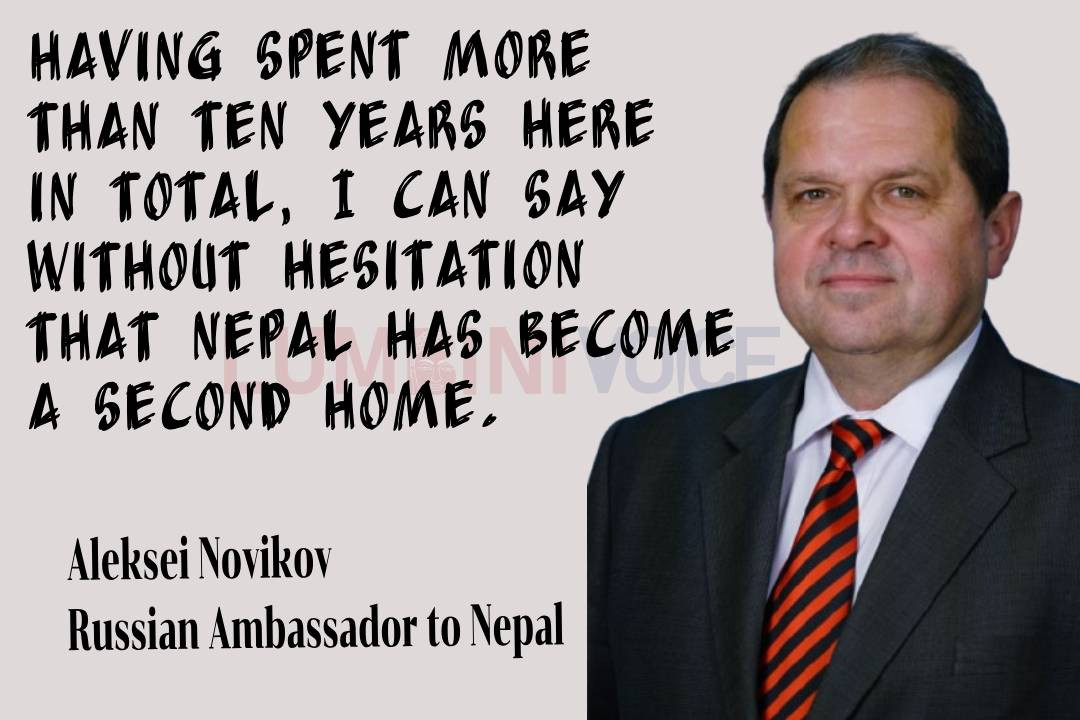
Nepal is a truly remarkable country, one that has become very special to me personally. Having spent more than ten years here in total, I can say without hesitation that Nepal has become a second home. I will carry with me not only professional experience, but also many warm friendships and memories of this beautiful land and its kind, resilient people.
Looking ahead, I am deeply optimistic about the future of our partnership. Next year will mark the 70th anniversary of diplomatic relations between Russia and Nepal an important milestone that symbolizes the strength and continuity of our friendship. I am confident that in the coming years, our cooperation will continue to expand across many areas.
We expect to see further growth in trade and economic exchanges, as well as in tourism -the area where the dynamics are already very encouraging. Cultural and educational contacts will remain a solid bridge between our peoples, while cooperation in energy, agriculture, and humanitarian fields will create new opportunities for development.
I truly believe that the next decade will bring even greater understanding and partnership between our two countries, grounded in mutual respect, shared interests, and the sincere goodwill that has always characterized Russia–Nepal relations.